590nm IR

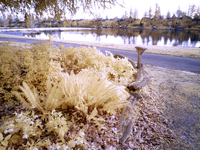
This is what the raw looked like without the red/blue channel swap and the other curve tweaks:
100c.jpg
 
Sincerely, I'm not sure I love the red/blue swap (not talking about politics, here), but I appreciate this experimentation and the yellow ferns are very interesting and detailed.
 
the yellow ferns are very interesting and detailed.
My wife took an iPhone shot because the ferns and the other plants were such an intense green
 
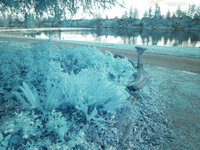
The blueish/green is what I see through the viewfinder of the converted camera. The camera auto focuses correctly.

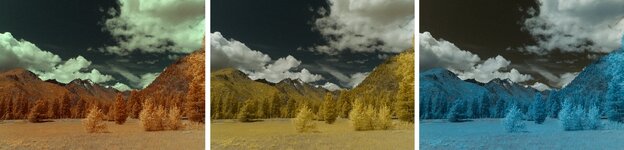
IR 3 ways.jpg

The far right is what I see through the VF. The middle is with just a red/blue channel swap and the far left tweaks the middle with some curve play in post.
 
I’m usually wary of colour IR, but this is certainly a very interesting experiment. Aside from some technical uses, I’m never quite sure what to do with such ‘other-worldly’ images.

I always remember a nice quote, but cannot recall who is attributed to it; “A photographer is someone who knows how to shoot with infrared film, but chooses not to!”. ;) Don’t let that put you off though as I really do find the images and the various process experiments very interesting. I should use my IR (and UV) cameras more, especially as they are used so little for work these days.
 
Pretty much invisible. It is ‘seeing’ the temperature difference.
I didn't know that IR would do that. I thought you would need thermal imaging.
 
You are right and my description wasn’t really sufficient to describe what is going on, Thermal cameras measure the amount of infrared (IR) radiation being emitted by an object and operate typically in the mid to far IR spectrum (MIR and FIR). Digital cameras that have had their IR filter moved operate in the near IR (NIR) and by adding filters that prevent visible light from being transmitted they can become very selective (the camera used in the image only registers light with a wavelength longer than 830 nm, although not into mid or far IR). It is limited because it is only capable of measuring reflected light whereas thermal cameras amplify the signal from emitted radiation and ‘colour-code’ them according to waveband.

At 830 nm the sensor is detecting the amount of NIR reflected by a subject (hence light foliage from plants that reflect NIR, but absorb visible light) and something similar is happening in the image shown. The tissue around the veins is absorbing more NIR than the veins, and that is because deoxygenated haemoglobin reflects NIR more than the surrounding tissue (making the veins visible) whereas oxygenated haemoglobin absorbs it in a similar way to tissue (and most larger arteries are ‘deeper’ than veins) and so are not visible. It has even been proposed as a way to improve certain clinical practices, but has limitations as it only works well on those ethnicities with light skins.

Another interesting ‘artefact’ of NIR imaging is that polyester textiles (like many synthetic polymeric materials) often become semi-transparent in an image as they do not absorb much IR radiation and so you do need to be cautious when photographing people using a modified camera! It is also why such modified cameras are used to study ‘below the surface’ of certain artworks and other materials (our interest).
 
Thanks for that Pete! You know a lot more about this that I do. I had seen IR images posted to various sites and thought it would be interesting to experiment with IR so I go the gx85 converted to 590nm. Now I feel that I possibly should have gone with full spectrum and used added filters. The Kolari conversion allows you to skip all of the focus issues and you actually can use the camera VF to frame and focus your shot. It's just that I've become bored with the typical results you get from 590nm.
 
Back
Top