How do you get great night shots with your camera?

Vivi Cheng

New Member
I’ve been struggling with night photography lately. My photos always come out too dark, blurry, or grainy.

What settings or tips do you guys use for better night shots? Let’s share!
 
Hi Vivi, and welcome to RPF.

Are you using film or digital capture?

I suspect that the blurring is mostly due to the slow shutter speed that the low light conditions require and the only real solution there is to provide a more stable platform for the camera. This could be a tripod, but even holding the camera against a static object such as a lamp-post, the roof of a car or similar can make a huge difference.

The graininess can be exploited as a ‘feature’ of a low-light image and can add significantly to its aesthetic. However, there are ways to reduce it by choosing either a film with greater sensitivity (high ISO rating), using higher ISO setting on a digital camera or a camera with a larger sensor.

Taking a meter reading at night is often prone to error, either because of the poorer sensitivity / accuracy of many meters in low light and also because of the dominance that even small point sources can have on the reading you obtain. This will result in dark images. Avoiding such highlights and using a more-point source way of metering can help, especially if you meter off of areas that are providing ‘moderate’ levels of refection of the light available (eg road surfaces).

Does that help?
 
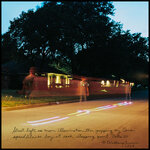
For example, here the image was metered avoiding the highlights and the mid-tone was paving to the left of the subject.

 
As like Pete want to know: film or digital? Although my film cameras now far out number my digital ones I have never shot at night with any of the film bodies - mostly because digital is so much easier at night. Then, there is the question of street v. astro? Again, I have never been interested in just shooting at night while wandering but shooting the stars does get my interest. While you would think that simply bumping the ISO up would do the trick, it is really more about the length of exposure.

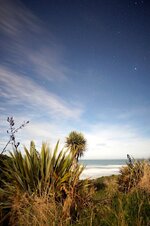
This was taken at the beach, mounted on a tripod. Exposure was just long enough so I didn't start catching the movement. You can see the silhouette of Haystack Rock in Cannon Beach in the lower left and the glow of beach camp fires lower center. The bright dot middle right is Venus and the reddish dot above and to the left is Mars. The digital camera used has a special "Starry Sky" focus mode that allows the camera to get a good focus on stars.
beach astro.jpg
 
your shutter speed should be 1/focal length to prevent camera shake when handholding. choose a wider lens to give yourself more room with your shutter speed. if you're shooting street like pete is, then you'll probably want to go handheld.

if you're shooting landscapes, like gary and i do, then definitely use a tripod and you can go even slower on your shutter speed.

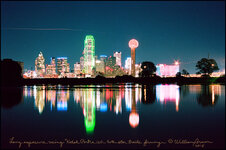
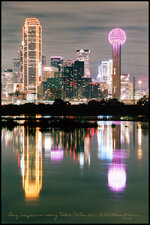
if you're shooting digital then lens is and ibis will help you. this shot was handheld (taken after the fair closed and all other lights were turned off) and i truly did not expect it to come out.

54mm, 1/20 sec, f/8, iso 1600

53880052114_31915ef868_o.jpg
 
Hi, Vivi, and welcome. You've come to the right shop for advice as Pete, Gary and Beth have demonstrated.
At the risk of repeating some of what they've said here's mine.
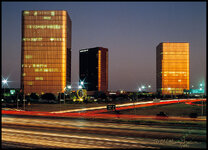
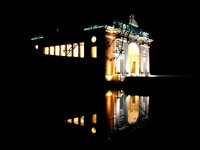
Remember the obvious: it's night time. Your eyes are attuned to it and light sources are not actually as bright as may seem. Sunny sixteen doesn't work here. Take a meter reading if you haven't got a separate meter (I usually manage to forget mine) use your camera close in to the bright area and if you're using digital you can check what white balance is best at the same time. These are tripod shots achieved using that method, time exposures, at ISO 200 I think.
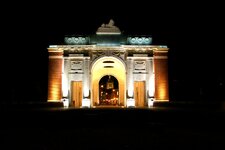
21-Ypres 0414 170.jpg

20-Ypres 0414 169.jpg

It's worth pointing out that my son was with me when I took these and was too impatient to wait for his turn to use the one tripod we were sharing. He took similar images with a considerably higher ISO without much difference to the end result. You'll have to take my word for that as I don't have his versions to hand.


Film, of course, is a slightly different matter and can be just luck of the draw. Even if the camera has some information in the viewfinder you probably won't be able to see it at night. Here I advantage of a frosty night to capture the textures of this railway crossing. With the camera on a tripod and the shot set up to emphasize the strong leading lines a waited for a train to pass. A frosty night meant that the electrical pick-ups were throwing up sparks from the conductor rail, just enough to fill in the otherwise empty top corners of the frame.
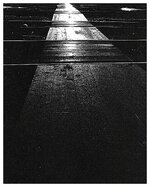
41-Timeitwas_0059.jpg
Sadly I have no details of the settings as that dates back long ago and the negatives and notes from those days have been lost. But I do know that I was doing a lot of that sort of thing then which brings me to my last piece of advice. Practise and practise again, making notes as you go to find out what works and what doesn't. Don't let your failures get you down, we all make them.

I hope that helps and best of luck, I look forward to seeing some of your work.

 
Last edited:
The main problem as is mentoined is large areas of black making your meter overexpose. A reading as close to and only of your subject as possible helps. For portraits at night a reading off your hand in the same light as the subject is effective. The attached shot was taken in the pitch black but iwth my Sony A3000 on aperture auto. The stars are the giveaway.
 

Attachments

  • pitch black.jpg
    pitch black.jpg
    138.8 KB · Views: 0
With street photography, at night, I am always looking for any pools of light that I can find. I have found that underexposing by about 1.3 stops gives me the best results. I do enjoy doing long exposures at night too. I usually find myself without a tripod, so I have to find something to stand the camera on! For these, with digital it's usually 2 second timer, ISO 100 and f/11 & with a shutter speed for as long as it has to be to get a decent exposure. Again, I often find I have ended up about a stop or so under what the meter is telling me I need - I like black to be b-l-a-c-k!

This one was shot off the floor on the edge of the harbour.
Agia Efemia, Kefalonia

55144506725_2da25f4544_b.jpg


Sony A6000 / Sigma 16mm f/1.4 @ f/11 for 5 seconds. ISO 400


This one, off a fence post!
St. Julian's, Malta

55144293958_f6dcd25bb8_b.jpg


Sony A6000 /
18-50mm f/2.8 @ ƒ/16 for 30 seconds, ISO 100


For film, I try to use the same principles but shutter speed is mostly educated guesswork but I will sometimes use aperture priority, if I trust the camera.

Lancaster Castle

55144410499_6d440c8fde_b.jpg


Pentax LX / SMC M 50mm f/1.4 / Ilford XP2 developed in 510 Pyro


Lancaster Town Hall in reflection

54065088473_f9983c801f_b.jpg


Pentax LX / SMC M 50mm f/1.4 / Ilford XP2 developed in 510 Pyro
 
Back
Top