Shinestacker Trials

Wes Hall

Well-Known Member
How does everyone find macro photography? Me, I’ve fascination and a raft of associated hobbies that provide endless subjects.

And today I’ve come across a new software package that’s made the D.O.F issue somewhat a micro trouble.

Trying out Shinestacker, fee to use and works with Linux so good start, but the real gem is how (relatively) simple and straightforward the UI and process is- unusual experience for me after attempts with Huggin.

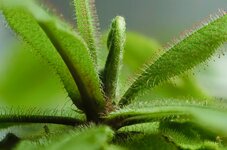
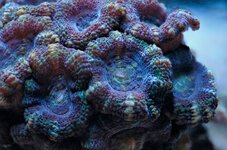
Couple of attempts from today- static subjects really are a must as you will see from my harlequin shrimp attempts using a ‘twist & burst’ method on the D2HS 😅
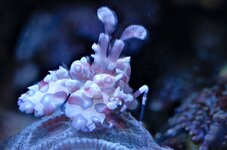
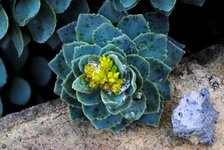
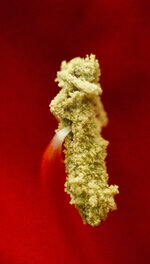
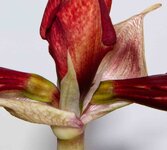
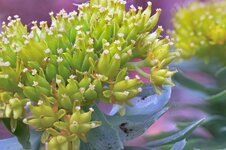
Harlequin Stack 6 images.jpegSword Leaf Sundew Stack.jpegMicromusa Stack-1-1.jpeg

More experiments to run with this software but so far, very impressed.
 
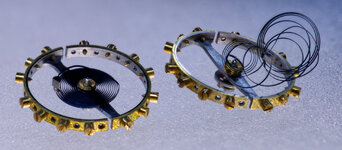
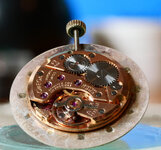
I'm not sure that I have ever mastered the whole stacking problem. Affinity Photo has stacking as an option when your opening a set of images. I usually use a focus rail and try to increment my way from front to real but that ends up with me wondering if I'm not actually changing the perspective. I've used the internal stacking on my mFT bodies and it's OK. A lot of what I've done are flowers and watches.

Your images are fantastic!

good and bad.jpg

73.jpg
 
Thanks Gary- similarly those watch pictures certainly look fantastic- seeing the jewels is impressive!

The way you’ve said with the focus rail sounds like it’s capturing the images to merge- so far I’m using the lens barrel to move from front to back (vice versa) at a fixed f stop to capture the whole subject.

I was inspired by your watch movement images and took a macro of my Seiko.

Seiko Titanium Alba Stack.jpeg

Definitely an agreeable subject compared to corals 😄
 
Some very nice results. I have not come across either Huggin or Shinestacker. I have always used Helicon Focus and, although I have a license for ZereneStacker too, I have only used it rarely.

These threads might be useful / interesting.


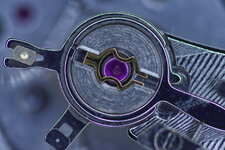
Here's a jewel setting (with jewel).
inca2.jpg

You pinch the brass piece with a set of tweezers and the two legs (on the right at about 4 o'clock) come free from the undercut and then the brass piece pivots up to the left allowing the purple jewel to be removed/replaced.

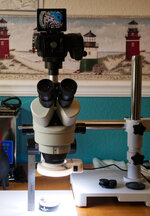
I think this was shot through the microscope (although that's not what's under the scope in the shot below). Camera is Sony a65.

whole rig1.jpg
 
Last edited:
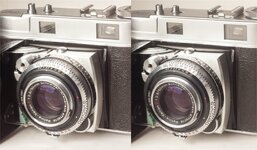
I haven't gone as close as you guys but I did a comparison between F22 and a 10 shot stack using the same process as Gary, slider plus Affinity. A bit subtle but there is much more clarity in the lens details. F22 left, stack right just for completeness.
 

Attachments

  • comparo.jpg
    comparo.jpg
    233.8 KB · Views: 4
Thanks for sharing Tony, it’s certainly revealed more details across the whole camera- I’m finding appreciation with this method for close up rather than true 1:1 macro- it’s good for creating that whole image detail for sure.

Incidentally, a couple more trials, this time with my SD15 and 50mm macro- I feel different sensors really impact the results and artifact potential- with the Fuji XE being the weakest so far.

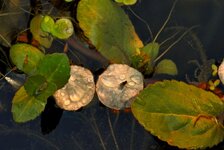
sd15 stack.jpegsd15 pond scene stack.jpegsd15 flower stack.jpeg
 
What a wonderfully painterly effect you have created in that last one, Gary.

Focus stacking can often result in a sort of ‘hyper-real’ look. This doesn’t. Similarly, specular highlights can be tricky to ‘control’ and the water droplet is your shots, Wes, are nicely lit and do not suffer from this at all.
 
Thanks for sharing Tony, it’s certainly revealed more details across the whole camera- I’m finding appreciation with this method for close up rather than true 1:1 macro- it’s good for creating that whole image detail for sure.

Incidentally, a couple more trials, this time with my SD15 and 50mm macro- I feel different sensors really impact the results and artifact potential- with the Fuji XE being the weakest so far.

View attachment 23705View attachment 23706View attachment 23707
I have always admired the SD series rendering which is so much better than a CMOS. A CCD comes closer. I must try some macro with my old Olympus C2000Z.
 
I have always admired the SD series rendering which is so much better than a CMOS. A CCD comes closer. I must try some macro with my old Olympus C2000Z.
I’ll look forward to seeing the results if you care to share Tony.

As I continue down this rabbit hole, I’ve learnt some limits to my PC- I can’t stack images larger than 4.6mb and not more than 5 at a time 😅 I had the super brain idea to convert the raw files from the SD15 into double size JPEG’s- about 13mb each- and then stack…

Yep, 8gb of RAM wasn’t cutting it.

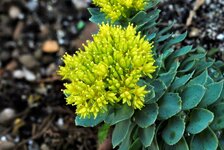
So I got creative, and combined several stacks together to create the following of what I’ve now identified as Rhodiola rosea- Rose root- a beautiful sedum that’s been in my garden forever and yet I’ve never taken such notice of it to try and identify it. Had no idea it’s both native and reportedly medicinal.

SD15 Sedum Stack.jpeg

Pete; wholeheartedly agree about Gary’s last macro shares, they have artistry beyond purely analytical studies. Thanks for the kind words on my shots too.
 
I’m finding appreciation with this method for close up rather than true 1:1 macro
I think the wider shot of the Amaryllis may not be a stacked macro. I don't seem to have a file that shows that crop and the posted image has no exif. This usually means that I cropped it with Paintshop Pro.
What a wonderfully painterly effect you have created in that last one, Gary
Thanks Pete.
It was shot in February of 2023 with my a7R3 with the 28-200 Tamron on 28mm. I don't think it is technically a macro nor was it stacked.
 
I’ll look forward to seeing the results if you care to share Tony.

As I continue down this rabbit hole, I’ve learnt some limits to my PC- I can’t stack images larger than 4.6mb and not more than 5 at a time 😅 I had the super brain idea to convert the raw files from the SD15 into double size JPEG’s- about 13mb each- and then stack…

Yep, 8gb of RAM wasn’t cutting it.

So I got creative, and combined several stacks together to create the following of what I’ve now identified as Rhodiola rosea- Rose root- a beautiful sedum that’s been in my garden forever and yet I’ve never taken such notice of it to try and identify it. Had no idea it’s both native and reportedly medicinal.

View attachment 23712

Pete; wholeheartedly agree about Gary’s last macro shares, they have artistry beyond purely analytical studies. Thanks for the kind words on my shots too.
I will certainly post something if I get anywhere. My Olympus only gives jpeg or tiff, a bit before raw became so common. Will investigate what Affinity can do.
 
Back
Top